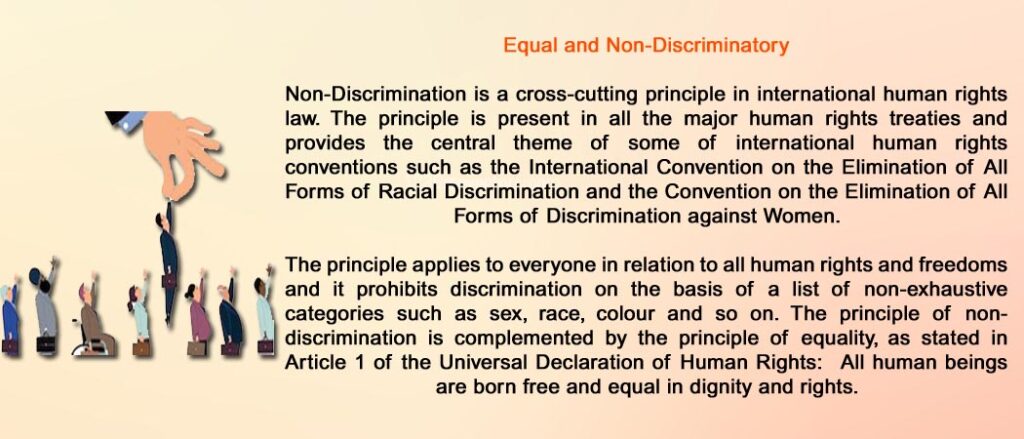
Human rights are the fundamental rights and freedoms that belong to every person in the world, from birth until death. They are inherent to all human beings, regardless of race, sex, nationality, ethnicity, language, religion, or any other status.
Core Principles of Human Rights
-
Universal: They apply equally to everyone, everywhere around the globe.
-
Inalienable: They cannot be taken away, surrendered, or transferred. They can only be restricted in highly specific situations and according to due process (for example, the right to liberty may be temporarily restricted if a person is found guilty of a crime by a court of law).
-
Indivisible and Interdependent: All human rights are of equal importance and are intimately linked. The fulfillment or improvement of one right often facilitates the advancement of others, just as the deprivation of one right adversely affects the rest.
Key Examples of Human Rights
Human rights encompass a broad spectrum of civil, political, economic, social, and cultural protections, including:
-
The right to life, liberty, and personal security.
-
Freedom from slavery, torture, and cruel or degrading treatment.
-
Equality before the law and the right to a fair trial.
-
Freedom of thought, conscience, religion, opinion, and expression.
-
The right to work, access to education, and an adequate standard of living (including food, clothing, and housing).
The Foundation
The modern international framework for human rights is built upon the Universal Declaration of Human Rights (UDHR). Adopted by the United Nations General Assembly in 1948 in the aftermath of World War II, it marked the first time in history that countries agreed upon a comprehensive list of inalienable human rights designed to be universally protected.